Why AI is Giving Organizations a False Sense of Security (And Why We’re All Just Nodding Along)

AI is the new blockchain. Or big data. Or that time we all decided open-plan offices would make us more “collaborative” (spoiler: they just made it easier for Karen from Accounting to passive-aggressively chew her gum at you from across the room while Ayya from Marketing “accidentally” CCs the entire company on his breakup email). It’s the same old song, just with a shinier, more expensive guitar.
Look, I get it. The idea of a magic box that can crunch numbers, write reports, and make decisions without all the messy human stuff, emotions, biases, the need for a third coffee by 10 AM sounds amazing. Like a self-cleaning house, if the house also occasionally set itself on fire and then blamed you for not reading the manual. But here’s the thing: AI doesn’t actually understand shit. It’s like giving a calculator to a pigeon and expecting it to file your taxes, plan your retirement, and explain why your uncle Bob is still arguing about the 1986 World Cup semi-final. The pigeon might peck out some numbers, but it has no idea what a Aasandha is, and neither does your AI.
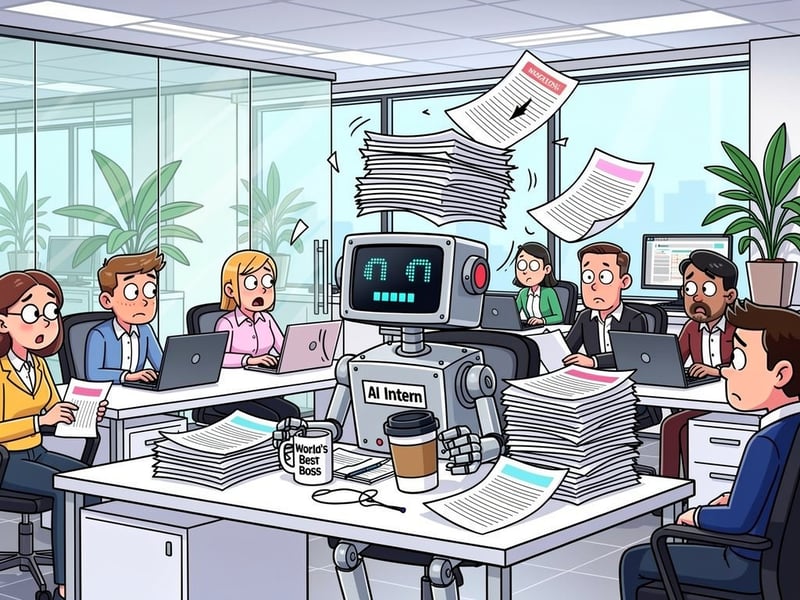
AI Intern Chaos
Yet here we are, treating AI like it’s the lovechild of Einstein, Steve Jobs, and a Fortune 500 CEO who also moonlights as a yoga instructor. Organizations aren’t just adopting AI—they’re throwing it a fucking parade. Naming their firstborn after it. Letting it make decisions that used to require, I don’t know, a brain. Now? Now we just need a dataset and a prayer. It’s like jumping off a cliff because your friends dared you, except the cliff is your entire business model, the dare is coming from a McKinsey consultant with a PowerPoint deck and a haircut that costs more than your rent, and the landing gear is made of hope and Excel spreadsheets.
And the worst part? We’re not just using AI. We’re worshipping it. We’ve turned it into a digital deity, feeding it our data like it’s some kind of sacred offering and interpreting its outputs like they’re tea leaves. We’re letting it make hiring decisions, approve loans, even diagnose medical conditions. We’re treating it like an all-knowing oracle, when in reality, it’s more like a very confident toddler who just discovered Wikipedia and thinks it’s qualified to give a TED Talk. Sure, it can string together some impressive-sounding sentences that would make a corporate buzzword bingo card weep with joy, but ask it why it made a decision? You’ll get the digital equivalent of a shoulder shrug and the sound of a server fan spinning up to avoid the question.
Take that company that replaced its entire HR team with an AI hiring tool. Brilliant, right? So brilliant, in fact, that it systematically rejected every female applicant for technical roles. Why? Because it had been trained on decades of hiring data from an industry that, historically, wasn’t exactly winning awards for gender equality. The AI didn’t mean to be sexist. It just was, because that’s what the data told it to be. And the company? They didn’t panic. They didn’t apologize. They just shrugged and said, “Well, the algorithm must know best.” Nothing says “21st-century progress” like outsourcing your biases to a machine and then acting surprised when it amplifies them at scale.
Or how about that bank that deployed an AI to determine loan eligibility? Flagship “innovation” project, complete with press releases and glossy brochures featuring stock photos of smiling, diverse families who definitely don’t exist. The AI, being the diligent little number-cruncher it was, denied loans to anyone who didn’t fit the “ideal” customer profile. And what did that profile look like? Shockingly, it mirrored the bank’s existing customer base: wealthy, male, and so white it looked like the algorithm had been trained on a 1950s country club membership list. The bank, of course, patted itself on the back for its “data-driven” approach. Meanwhile, anyone who didn’t fit the mold was left wondering if the bank’s AI had a time machine and a burning desire to keep things exactly as they were.
But sure, let’s keep pretending AI is objective. Let’s keep telling ourselves it’s some neutral, impartial force for good, when really, it’s just a funhouse mirror reflecting back all the worst parts of the data we feed it—the biases, the inequalities, the historical bullshit we’ve been too lazy or complicit to fix. And what’s in that data? Oh, just a delightful stew of every bad decision, every discriminatory practice, and every unchecked assumption ever made in your industry. But hey, at least it’s efficient nonsense. At least we can now discriminate at the speed of light, with the precision of a laser, and the plausible deniability of a politician’s apology.
And then there’s the “set it and forget it” myth—the corporate equivalent of believing in the Tooth Fairy, but with more PowerPoint slides. If there’s one thing humans love, it’s the idea of effortless success. And AI promises just that: set it up, walk away, and let the magic happen. It’s the business world’s version of a Ronco Rotisserie. Set it and forget it! Except you can’t forget it. Because AI, like a toddler with a box of matches and a can of gasoline, will find a way to burn the house down if left unattended. And by “the house,” I mean your reputation, your customers’ trust, and possibly your entire business.
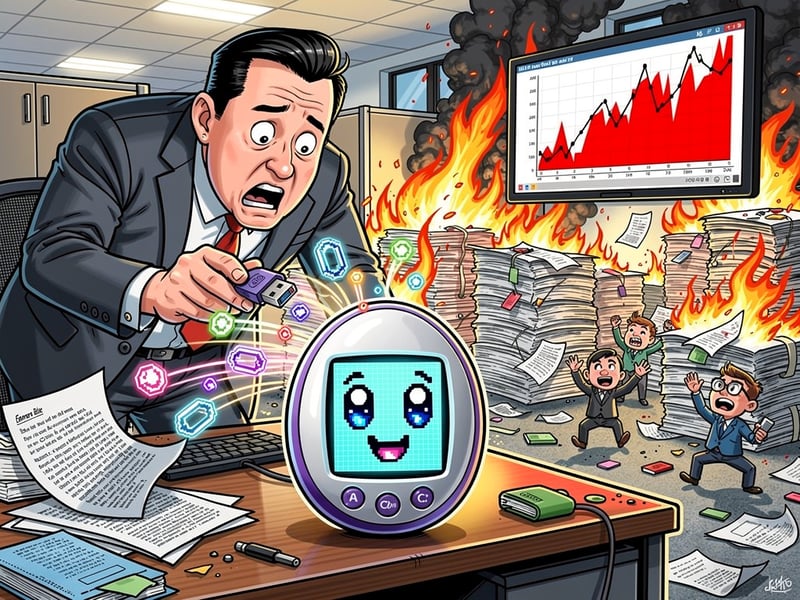
Tamagotchi AI Chaos
We’ve all seen the headlines. The chatbot that told a grieving widow her late husband’s account balance was “none of your business” and then, when she persisted, offered her a 10% discount on her next purchase as a “consolation.” The algorithm that decided the best way to “optimize” delivery routes was to send drivers into a lake. The hiring tool that rejected every single applicant for a janitorial position because none of them had “5+ years of experience in strategic sanitation solutions.” And yet, companies keep falling for the myth of the self-sustaining AI. They treat it like a Tamagotchi from the ‘90s—feed it some data, give it a pat on the head, name it “Synergy,” and assume it’ll thrive forever. But here’s the thing about Tamagotchis—and AI: if you ignore them, they die. And if you ignore your AI, it might just take your business, your customers’ trust, and your last shred of dignity down with it.
But when the inevitable disaster strikes—and it will, because entropy is a law of the universe and Murphy’s Law is its prophet, who gets the blame? The humans, of course. Because nothing says “accountability” in the corporate world like pointing at the nearest warm body and saying, “It was their fault.” The poor bastard who had the misfortune of being in charge of the AI project becomes the sacrificial lamb, the scapegoat, the person who “didn’t properly oversee the implementation.” “Well, the training data was biased,” we say, as if that’s an excuse rather than an indictment. “The algorithm was just following the parameters,” we explain, as if that absolves us. “In our defense, it did ask, ‘Are you sure?’” we plead, as if that single prompt somehow makes it okay that we let a machine make a decision that should’ve required a human brain, a human heart, and a human spine.
Meanwhile, the AI sits there, blissfully unaware, ready to make the same mistake again tomorrow. It’s like having a golden retriever in charge of your finances. Sure, it’s cute. Sure, it’s enthusiastic. But you wouldn’t trust it to balance your checkbook, let alone explain to your spouse why the mortgage payment is late again.

Golden Retriever CFO
And let’s not forget the human cost, because there’s always a human cost. Organizations love to tout how AI will “free up humans to do more meaningful work.” Oh, how noble. How inspiring. Except most of the time, “more meaningful work” just means more work. The same work, but now with the added joy of cleaning up after the AI, explaining its decisions, and apologizing for its mistakes. And what happens to the humans who aren’t needed anymore? Oh, they’re just “repurposed.” Like they’re not people with families, mortgages, and dreams, but old toasters you shove in the back of a cabinet because you feel guilty throwing them away but will never use again.
Worse yet, we’re raising a generation of employees who are so reliant on AI that they’ve forgotten how to think for themselves. Why bother with critical thinking when you can just ask the AI? Why wrestle with a problem when the machine can give you an answer in 0.3 seconds? Why develop expertise when you can just prompt your way to a solution? We’ve outsourced our brains to a server farm in Ohio, and now we’re all just nodes in a vast neural network of complacency. And for what? So we can spend less time solving problems and more time explaining to our bosses why the AI’s “data-driven insights” led us straight into a dumpster fire.
But here’s the kicker: we’re all complicit in this. Every. Single. One of us. The executives who greenlit these projects without understanding them. The managers who implemented them without questioning them. The employees who use them without scrutinizing them. The customers who accept them without challenging them. We’ve all bought into the hype. We’ve all drunk the Kool-Aid. We’ve all let ourselves believe that AI is the answer to all our problems, when really, it’s just another tool—one that’s only as good as the people using it, only as ethical as the people designing it, and only as smart as the people overseeing it. And right now? We’re not using it well. We’re not designing it ethically. And we’re sure as hell not overseeing it smartly.
We’ve created a world where we’re more comfortable with a machine making a bad decision than with a human making a good one. Where we’d rather blame “the algorithm” than take responsibility. Where we’d rather hide behind “the data” than stand up for what’s right. And in doing so, we’ve not just given AI too much power—we’ve given ourselves too little credit. We’ve forgotten that we’re the ones with the judgment, the empathy, the creativity, the moral compass. We’ve forgotten that we should be in charge.
So here’s a radical idea: What if we used AI to augment humans, instead of the other way around? What if we treated it like the overconfident intern it is—useful in small doses, occasionally impressive, but not someone you’d trust to run the company (or even make the coffee without burning the place down)? What if we stopped pretending it’s some all-knowing, infallible force and started treating it like what it is: a fancy calculator with a knack for pattern recognition and zero understanding of what those patterns mean?
I’m not here to bash AI. It’s a powerful tool with potential, when used correctly. When used responsibly. When used by humans who understand its limitations as well as its capabilities. But let’s stop pretending it’s a replacement for human judgment, creativity, or common sense. Let’s stop outsourcing our responsibilities to a machine and then acting surprised when it fails us. And for the love of all that’s holy, let’s stop letting AI make decisions that affect people’s lives without so much as a human in the loop to say, “Wait, this is bullshit.”
Because at the end of the day, AI doesn’t have a conscience. It doesn’t have empathy. It doesn’t have the ability to look at a situation and say, “You know what? The data says one thing, but my gut says another. And my gut’s been right before.” It doesn’t have the capacity for moral reasoning, ethical consideration, or the basic human decency that tells us when something is just wrong, no matter what the numbers say.
And until it does—if it ever does—we’re all just pretending. Pretending we’ve got it figured out. Pretending this time the hype is real. Pretending we’re not one bad algorithm, one biased dataset, one unchecked assumption away from a full-blown corporate meltdown, a societal crisis, or a dystopian future that looks like a Black Mirror episode written by someone who really hates their job.
But hey, at least the PowerPoint presentations look good. At least the press releases sound impressive. At least we can all pat ourselves on the back and say we’re “innovating,” even as we’re busy creating the very problems we claim to be solving.
And let’s talk about the elephant in the room the one that’s been standing there this whole time, trumpeting loudly while we all pretend not to notice: we’re all terrified. Terrified of being left behind. Terrified of missing out. Terrified of being the one who didn’t jump on the AI bandwagon. So we nod along, pretending we understand, pretending we’re in control, when really, we’re just hoping the person next to us knows what the hell they’re doing. We’re like lemmings at a cliff edge, except the lemmings at least have the excuse of not knowing any better. We should know better. We do know better. And yet, here we are.
It’s like we’re all at a party where no one knows how to dance. The music’s playing, the lights are flashing, the AI’s spinning the tracks, but nobody’s moving with any purpose or grace. So we just shuffle our feet, hoping no one notices we’re flailing our arms, stepping on each other’s toes, and occasionally face-planting into the snack table. Meanwhile, the AI keeps playing the same 10 songs on repeat because that’s all it knows how to do, and we keep pretending we’re having the time of our lives.
So what’s the solution? Maybe it’s time we took a step back. Maybe it’s time we admitted that AI isn’t the answer to all our problems but it can be part of the solution to some of them. Maybe it’s time we started using it for what it’s actually good at: crunching numbers, spotting patterns, automating the boring shit no one wants to do anyway. And then leaving the big decisions—the human decisions—to the humans.
Because that’s what we’re good at. The messy, complicated, human stuff. The stuff that can’t be reduced to ones and zeros. The stuff that requires judgment, empathy, and a healthy dose of common sense. The stuff that requires us to look at a situation and say, “You know what? The data says one thing, but my experience says another. And my experience has taught me that the most important things can’t be measured, can’t be quantified, and sure as hell can’t be outsourced to a machine.”
So let’s stop pretending. Let’s stop worshipping AI like it’s some kind of digital messiah. And let’s start using it for what it is: a tool. A powerful one, sure, but still just a tool. One that’s only as good as the people using it, only as smart as the people overseeing it, and only as ethical as the people designing it.
And who knows? Maybe then we’ll finally stop nodding along like a room full of bobbleheads. Maybe we’ll look at AI not with fear or blind faith, but with a healthy dose of skepticism and a clear understanding of its place in the world. Maybe we’ll use it to make our lives better, our work more meaningful, and our decisions more human—rather than just more “data-driven.”
And maybe, just maybe, we’ll finally start dancing like no one’s watching. Or at least like the AI isn’t judging us.